

Kintetsu Department Stores Co., Ltd., which operates department stores primarily in the Kansai area, is restructuring its business portfolio, including expanding its franchise business and entering the agricultural business, and is proceeding with the development of its IT infrastructure, mainly by migrating various systems to the cloud. However, in the process of this advanced initiative, the company faced challenges regarding data integration between its on-premise mission-critical system, core system and the newly introduced SaaS, "TOKIUM Invoice." To solve this, the company introduced the cloud-based data integration platform (iPaaS) "HULFT Square," achieving secure data integration with a small team and in a short period of time. This has resulted in significant improvements in development time and cost, and is accelerating the in-house development of data integration.
Customer Issues
- In data integration between on-premises and SaaS systems, there were many obstacles, such as building API servers and designing authentication and security, resulting in significant time and cost expenditure with each development step.
Benefits of implementation

A small team completed everything from script creation to implementation, achieving secure data integration.

This eliminated the need for new development of data integration platform, shortening the development period from several months to several weeks and reducing costs by approximately 10 million yen.

We can quickly respond to business changes and needs and establish an environment that enables in-house data integration
To bring development in-house, it is essential to establish data integration platform that can be used universally and reusably.
Kintetsu Department Store Co., Ltd., as a core company of the Kintetsu Group, is responsible for the retail business and operates stores in Osaka, Nara, Wakayama, Shiga, and Mie prefectures. In recent years, the company has been pushing forward with transformation, setting forth its vision as a "platform provider that enriches people's lives" (Medium-Term Management Plan 2021-2024) and a "department store that provides new value" (same plan 2025-2028).
The core of this initiative is its franchise business. The company operates stores under franchise agreements with other brands such as "Cainz," "Hands," and "Seijo Ishii," and employs a large number of its own staff for on-site sales operations, thus pursuing a unique approach in the industry to improve profitability. Furthermore, in 2023, it entered the agricultural business, handling everything from production to processing and sales of strawberries, mangoes, and other fruits, developing it into a highly profitable new business.
To cope with this business diversification and changes in revenue structure, the company's IT infrastructure naturally required greater flexibility and speed than before. Against this backdrop, the company proceeded with migrating various internal systems to the cloud and focused on creating an environment where server construction and other processes that previously took several months could be carried out more quickly in-house. The company also focused on expanding its use of data, for example, by using AI to improve the accuracy of budget formulation for each store based on sales data.
However, in order to efficiently promote DX, it is necessary to be able to smoothly link data between various systems, and the company had problems in this regard. Kensuke Iritani, Section Manager of the DX Promotion Department, Corporate Planning Division, recalls that this challenge became apparent when they replaced their existing on-premise expense reimbursement system with a new SaaS system with the aim of streamlining and going paperless with expense reimbursement operations.
"Our existing mission-critical system, core system was built on-premises, and data integration with our on-premises expense reimbursement system was handled through file transfer and batch processing using file transfer middleware "HULFT." On the other hand, "TOKIUM Invoice," which was newly introduced by the accounting department, is a SaaS, so data integration will be done using APIs. In other words, it's different on a 'language level' level. It was clear from the start that there would be many obstacles to overcome when integrating systems with such different connection methods, such as building API servers and designing authentication and security," said Mr. Iritani.
Given the limited number of personnel capable of handling APIs, building API servers and other infrastructure in-house is not impossible, but it would inevitably take a considerable amount of time. Outsourcing, on the other hand, would incur significant development costs. As mentioned earlier, with the company-wide policy of migrating to the cloud, and considering the expected increase in SaaS adoption in the future, spending such time and money each time is not realistic. Therefore, developing a general-purpose, continuously usable data integration platform had become essential.
After the proof-of-concept (PoC) demonstrated its potential, "HULFT Square" was selected, and the implementation project was completed with a small team and in a short period of time.
"HULFT Square" was selected as the tool to solve these problems. Mr. Iritani says that it was a natural progression for the company to focus on "HULFT Square" because they already had experience and a track record of using "HULFT" for file transfer in another internal system.
"Ultimately, the deciding factor in our selection was that, with the extensive support from Saison Technology's sales representatives before implementation, we were able to conduct a proof-of-concept (PoC) connecting our mission-critical system, core system with 'TOKIUM Invoice,' and we were able to see a clear path to full operation in a short period of time," said Mr. Iritani.
The "HULFT Square" implementation project proceeded in line with the "TOKIUM Invoice" implementation schedule and took approximately six months in total. However, the construction of "HULFT Square" itself was completed in a very short period without any particular problems. Moreover, only Mr. Iritani and one member from a partner company were involved in the project, and they were able to complete everything from script creation to implementation basically on their own. Mr. Iritani says that it was a great advantage that they did not need a large-scale development system like a quasi-delegation contract, and were able to allocate valuable internal resources to other projects.

Manager, DX Promotion Department, Corporate Planning Division
Kensuke Iritani
"Although this was our first time using HULFT Square, we were able to set up data integration smoothly. We did encounter some challenges, such as connecting across regions to the AWS environment where mission-critical system, core system resides, but we were able to overcome these issues without any problems thanks to the support we received from Saison Technology's pre-sales team, including the sharing of helpful implementation examples and advice. If we had tried to build our own API server instead of adopting HULFT Square, it would have been incomparably more difficult," (Iritani).
Significantly reduce development time and costs while achieving secure data integration between on-premises and SaaS.
Through these circumstances, the company was able to internally implement data integration between its mission-critical system, core system and "TOKIUM Invoice," and bring it to full operation in a short period of time as planned.
Originally, the company's expense reimbursement process involved entering invoice data into a custom-developed on-premise expense reimbursement system, which was then output as paper slips. The accounting department would then cross-reference these paper slips with the invoices for processing.
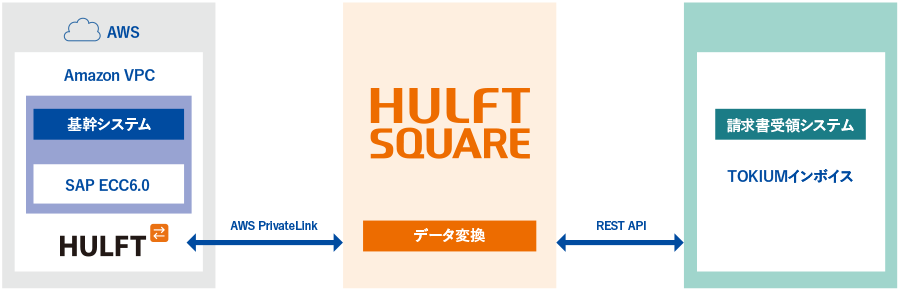
In contrast, the newly constructed system works as follows: when invoice data is entered into "TOKIUM Invoice," the extracted journal entry data is passed to "HULFT Square" via API for data conversion, and then automatically linked to mission-critical system, core system via "HULFT." Conversely, in the reverse direction, master data integration from mission-critical system, core system is output to a file and automatically registered and updated in the expense reimbursement system via "HULFT Square." This creates a system where expense reimbursement operations are completed entirely digitally.
What's important here is that by utilizing "AWS PrivateLink" to connect the AWS environment where mission-critical system, core system resides with "HULFT Square," a secure communication path is ensured without exposing the AWS environment to the outside.
"Without AWS PrivateLink, deciding on the best path to securely transfer data would have been a major problem, so this feature was extremely helpful," said Iritani.
Since the new system has only recently gone live, the staff are still in the transition phase from the familiar paper-based expense reporting process. Therefore, it will take some time before the system is fully established and quantitative effects become apparent. However, Mr. Iritani says that significant results of a different kind are already being achieved.
"The biggest achievement was that we didn't have to develop a new data integration platform such as an API server. If we had outsourced the construction of the API server, it would probably have required several months of development time, development costs of around 10 million yen, plus ongoing running costs. By using 'HULFT Square,' we were able to shorten the development period to just a few weeks, even with only one or two people who were using it for the first time, and keep costs down to just a monthly fee with no initial fees," said Mr. Iritani.
A more significant long-term benefit is the establishment of an environment where data integration development can be handled in-house. Previously, whenever data integration between systems was required, the company had to consult with development vendors if it was beyond their capabilities, and go through a long process of obtaining quotes, placing orders, and development, all while incurring significant costs.
"For example, simply integrating the master data of mission-critical system, core system used to take several months and cost several million yen if we outsourced it. With 'HULFT Square,' which enables no-code and low-code development, we can now do it ourselves and significantly reduce development time and costs. The increased options for data integration development and the ability to respond quickly to requests from management and the field are major improvements," says Mr. Iritani.
HULFT Square contributes to the development of IT talent and accelerates the in-house development of data integration.
Based on the success of this project, the company plans to further promote the in-house development of data integration using "HULFT Square." In particular, they have already begun considering the use of data stored in "BigQuery." Mr. Iritani envisions creating a system that extracts, processes, and integrates data using "HULFT Square" so that purchasing data and other information can be used for analysis across the entire Kintetsu Group.
"The vendor estimates that building a system to extract data from BigQuery and create files would cost several million yen, so if we can do this in-house, it would be a significant achievement," says Iritani.
Furthermore, to streamline the time-consuming task of manually extracting and processing organizational and employee change information to match various systems, they are also considering data integration that would automatically reflect change information from the HR system to "Google WorkSpace."
"There are many areas where we can use 'HULFT Square,' such as automating data extraction from existing systems. The introduction of 'HULFT Square' has increased costs in the sense that we now have a monthly usage fee that we didn't have before, so we want to expand the scope of its use to further improve its cost-effectiveness," says Iritani.
Furthermore, Mr. Iritani has high expectations for "HULFT Square" as a tool to cultivate IT talent through practical data integration and further accelerate in-house development.
"To respond quickly to business changes and internal and external needs, we wanted to improve our skills and be able to data integration ourselves, so we feel that 'HULFT Square' is the perfect tool for us. For companies with a strong in-house development orientation like ours, 'HULFT Square' is a strong option," says Mr. Iritani.
Recommended Content

Kintetsu Department Store Co., Ltd.
- Head office location: 1-1-43 Abenosuji, Abeno-ku, Osaka City, Osaka Prefecture
- Established: 1934
- Capital: 15 billion yen
- Number of employees: 1,962 (consolidated), 1,519 (non-consolidated) (as of the end of February 2025)
- Business Description: Established in 1934. Operates department stores primarily in the Kansai area. Aiming to transform from a traditional "department store" to a "department store" that offers new value, the company is diversifying its business by expanding into franchise operations and agriculture.
- The content of this case study is current as of the time of the interview. The content of this case study may change without notice.