

Why "Vote on Paper"? - Thinking about IT and "Safety and Security"

This is Watanabe from the marketing department.
This is a column that casually writes about various topics related to data, IT, etc.
Why aren't Japanese elections conducted electronically?
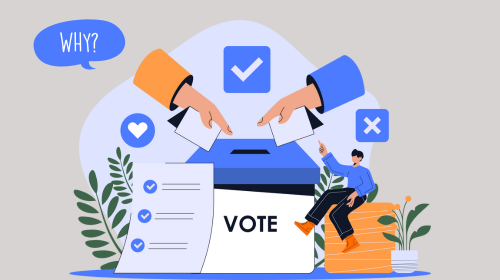
As I write this, there are many topics related to elections in the world. Every time an election comes around, I hear criticism of Japan's current situation, such as "Japan is behind the times because it doesn't have electronic voting." Every time I hear this, I think, "Safety and security are difficult in many ways," so I'd like to write about that today.
First of all, elections are a fundamental system in a democratic nation, so it is problematic that they are operated in a careless manner.
We must avoid situations such as one person being able to vote multiple times, tampering with voting results, or the intentional or deliberate deletion of voting data. In other words, a "proper system" is required. Furthermore, it would be problematic if the system allowed information about who voted where to be leaked.
In other words, a completely different level of care is required than when handling numbers in an average IT system. You might think that a voting function should be easy to create by just adding up numbers, but it's a completely different story from, say, creating a personal smartphone app, and it's not that easy.
On the other hand, some foreign countries have adopted electronic voting systems, and naturally, these countries have developed IT systems that address (for the time being) the issues mentioned above, and use them in elections.
Or, I know there are difficult circumstances, but I sometimes see people saying that other countries are operating electronic voting systems, so Japan should stop using paper votes.
How can we get everyone to agree with this?
I also believe that, technically, it is perfectly possible to create an electronic voting system, but I think the real difficulty lies in what comes after that.
For democracy to function, people need to have trust in the electoral system. Even if the election results are not what they hoped for, they need to be able to accept that it is unavoidable because the election was conducted according to proper procedures.
Even in situations where trust is shaken, such as when rumors of election fraud spread, it is desirable for a system to be able to maintain a healthy democracy if many people can still convince themselves that there is no fraud that could overturn the election results.
From that perspective, what about electronic voting systems? Engineers may be able to understand that they are "well thought out," but the average person probably wouldn't. Even for engineers, it can be difficult to judge whether the individual systems in front of them have been tampered with.
Let's say there are people who have come to believe that the machines were rigged and that the election was fraudulent. It would be very difficult to dispel that distrust. Even if you don't understand it, you might end up scolding them, saying that this is a good system created by the right people.
What about a paper vote?
Voting on paper significantly reduces suspicion in a way that is clear to everyone.
When you go to a polling station during an election, you will see a lot of people sitting there. This is not because there are a lot of people with nothing to do and it is inefficient. It is because the system is open to public scrutiny to ensure there is no fraud, such as coercion to vote, and this helps to maintain trust in the electoral system.
Similarly, the vote counting is also conducted under surveillance to check for any irregularities. For example, if a certain political party A suspects election fraud, it can prevent such irregularities by sending people to monitor the vote counting, and if the monitoring fails to find anything of particular concern, it will be easier for that party to accept the results.
It is technically possible to create a safe and secure IT system, but whether or not you can convince everyone that it is "safe and secure" is another matter.
It seems to me that a system where people vote by writing on paper is less likely to cause the credibility of the electoral system itself to be lost. An IT-based system is not superior in any way.
The reliability of space rockets and the safety and security of HULFT
However, since elections are held only once a year at most, it's possible to go to the polling station and vote by paper ballot. If there are elections every week, surely you'll have to wonder if you can vote from your smartphone?
If they have conducted the test many times, they should be able to convince the world with their safety and reliability. For example, they have launched a space rocket 100 times, where failure is not an option, and have only had one failure. This is how they have gained the world's trust.
For example, our product, "HULFT file integration middleware," has been trusted and supported for many years, and it has also been used for many years in mission-critical system, core system, where no mistakes are allowed, and has earned the trust of customers for its safety and security.
"Is that linked system really okay?" "We're using HULFT." "So, it should be okay for now."
The safety and security of paper voting cannot be underestimated, and I think that in the future, situations may arise where trust in the democratic system itself is called into question. So, while I think that paper voting is fine for the time being, I also feel that we cannot stick to paper voting forever into the distant future.
If Japan were to develop and adopt an electronic voting system, I hope that it would be one that people would think, "Japan's system has been in use for over 50 years, even before the 22nd century, and has an overwhelming track record without any accidents," and "Japan's system is reliable, so let's introduce it in our country too" (assuming that the concept of "nation and government" still remains in the world by that time).
The person who wrote the article
Related Content
-
I always find the "Yamazaki Spring Bread Festival" interesting in many ways – the possibilities of "adding a little something extra."
-
When the aurora appears, earthquakes occur, and when diaper sales lead to beer sales - it's surprising to see "unexpected correlations" in the world
-
"Miraculous comebacks" really do happen (quite often) - Kataller Toyama's miraculous J2 survival