

"Data exists, but it can't be used": Challenges and approaches to data utilization in the real estate industry.


In the real estate industry, a wide range of data is accumulated through development, sales, leasing, and management. However, when this data is scattered across different departments and systems, challenges arise such as "not being able to quickly access the necessary data" and "not being able to grasp the situation across departments."
This article explains the background and challenges of the need for data utilization in the real estate industry, as well as the mindset required to advance data utilization.
Why is data utilization important in the real estate industry now?
In the real estate business, on-site experience and the expertise of the person in charge have always played an important role. However, as market conditions and customer needs change, there are increasingly more situations where it is difficult to make decisions based solely on past experience.
For example, when acquiring or developing a property, it is necessary to make decisions by combining various pieces of information, including market data such as demographic trends, land prices, and the surrounding environment, as well as information on properties owned by the company and past transaction records. Even after development, it is necessary to maintain and improve the property's value by continuously monitoring sales, rental, occupancy, and repair history.
In other words, data utilization in the real estate industry is not simply about analyzing data.
It is important to combine multiple data sources to create a system where decision-making, which previously relied on experience and the judgment of individual employees, can be done more objectively and quickly.
"We have the data, but we can't use it": A challenge faced by real estate companies.
Even if data is accumulated within a company, it doesn't necessarily mean it can be used immediately when needed.
For example, property information may reside in a real estate management system, contract information in mission-critical system, core system, customer information in a CRM system, and accounting information in an accounting system; data may exist in different systems. When a company needs to check information for a management meeting, they may extract data from each system and then aggregate and process it using Excel or similar software.
Furthermore, if the data format and management rules differ from system to system, simply collecting the data will not allow for comparison.
the result,
- It takes time to find the necessary data.
- We are looking at different figures for each department.
- This involves transferring data to Excel and performing calculations.
- I cannot immediately check the latest information.
- When the person in charge changes, the method of data compilation becomes unclear.
This can lead to problems like these.
Even if you want to utilize data, the time-consuming steps of data collection and processing can prevent you from reaching the analysis stage. This situation becomes a major obstacle to advancing data utilization.
Systems optimized for each department create fragmentation across the entire company.
There's nothing inherently wrong with each department using a system suited to its specific tasks. In fact, implementing the optimal system for each task can improve productivity on the ground.
However, as the number of systems increases, the challenge of "connecting" data when utilizing it across the entire company becomes greater. If information held by the development department is managed separately from information held by the rental department, or customer information held by the sales department and property information held by the management department, then data needs to be collected every time cross-functional analysis is performed.
Even if individual systems are optimized, data is fragmented when viewed across the entire company. This gap is one of the factors that makes it difficult for real estate companies to utilize data effectively.
How will real estate data utilization change decision-making?
So, what exactly changes when we can utilize distributed data?
The purpose of data utilization is not simply to collect data or to perform advanced analysis. Ultimately, it is to make better and faster decisions in business and management.
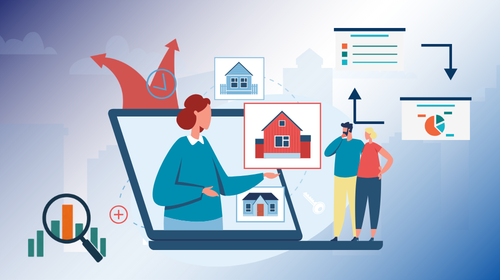
To be used in development and investment decisions
In real estate development, investment decisions are made based on a wealth of information, including location, market conditions, demographics, and past performance. By utilizing this data comprehensively, it becomes easier to make decisions that take into account not only past performance but also market changes and area-specific trends.
For example, it could be used to analyze what area and property characteristics contribute to business success by combining the performance of properties developed by the company in the past with external market data.
To be used to maintain and improve property value.
Developing a property isn't the end of the process. Continuously monitoring data such as rental status, move-in/move-out, repairs, construction, and revenue allows for a more accurate understanding of the situation for each individual property.
For example, by combining repair history with revenue data, you can analyze what kinds of repairs are impacting property value and profitability.
Beyond managing individual properties, it's also possible to utilize insights gained from past data for future repair plans and investment decisions.
To be used for cross-departmental management decisions.
Large real estate companies often use different systems for each business or department. Therefore, when management tries to understand the company's overall situation, they sometimes collect data from each department, process it using Excel or similar software, and create reports.
When data can be referenced using common rules, it becomes easier to grasp information across departments. You can more quickly check things like "which businesses are growing" or "which properties are experiencing changes in profitability."
Before proceeding with data utilization, first understand the "current state of your data."
When starting to utilize data, some people immediately consider introducing BI tools or AI.
However, before that, it's important to confirm "where the necessary data is located and how it's managed." No matter how advanced the analytical tools you implement, if the necessary data is scattered across multiple systems or if the data definitions are not consistent, you'll need to collect the data before you can perform any analysis.
Therefore, it is important to first organize the current state of your company's data.
Organize where and what kind of data is available.
First, we'll organize what systems exist within the company and what kind of data is being accumulated.
for example,
- What system is used to manage customer information?
- Where can I find property information?
- Which system should be considered the correct one for contract information?
- How are accounting and contract information linked?
- Are departments managing the same information redundantly?
We will check these points.
By organizing the data in this way, we can identify the challenges in current operations, such as data dispersion, duplication, and manual aggregation.
Think from the perspective of "what to connect" to "what to use it for."
When considering data integration, we tend to start with the question, "How can we connect this system to that system?"
However, the important thing is to clearly define what you want to achieve through that collaboration.
for example,
- We want to expedite business decision-making.
- I want to get a comprehensive overview of the profitability of each property.
- We want to improve the accuracy of our repair plans.
- We want to streamline information sharing between departments.
The necessary data and methods of integration will vary depending on the purpose.
By first deciding "what the data will be used for" and then organizing the necessary data and systems, you can prevent an increase in aimless collaborations.
▼I want to know more about data integration
⇒ data integration / data integration platform | Glossary
The option of a "data integration platform" to support data utilization
To utilize data distributed across multiple systems, a mechanism is needed to properly connect those systems.
Therefore, data integration platform becomes a viable option.
By utilizing data integration platform, data integration between various systems can be centrally managed, and integration can be easily expanded even when new systems or services are added. This is especially important for companies like large developers that use their existing mission-critical system, core system long-term while gradually introducing new SaaS and services. The idea of "connecting where needed while leveraging existing systems" is crucial.
▼I want to know more about SaaS
⇒ SaaS (Software as a Service) | Glossary
Flexible data integration with no-code iPaaS
iPaaS (Integration Platform as a Service) is a platform for building and managing data integration between different systems and services on the cloud. With no-code iPaaS, you can design and manage integration processes visually without complex programming.
If integration processes can be managed centrally, it becomes easier to understand the integration status even when the number of systems increases, and compared to building integrations individually, it is expected to reduce the burden of operation and maintenance.
▼Learn more about iPaaS (Integration Platform as a Service)
⇒ iPaaS | Glossary
HULFT Square enables data utilization that leverages existing systems.
HULFT Square is a cloud-based data integration platform "iPaaS," that enables the construction and operation of data integration between different systems without coding.
Because it allows for flexible expansion of integration with new systems and services while leveraging existing mission-critical system, core system and SaaS, it is suitable for companies that want to gradually advance data utilization, starting with what is needed, rather than completely overhauling all systems at once.

iPaaS-based data integration platform HULFT Square
HULFT Square is a Japanese iPaaS (cloud-based data integration platform) that supports "data preparation for data utilization" and "data integration that connects business systems." It enables smooth data integration between a wide variety of systems, including various cloud services and on-premise systems.
Utilizing real estate data is not a "connect and forget" process.
Simply linking data is not enough to complete data utilization. It's necessary to visualize and analyze the linked data and use the results to inform actual business and management decisions.
Then, the insights gained are reflected in the next measures, and more data is accumulated. By continuing this cycle, data becomes not just information, but an asset that supports corporate decision-making.
Therefore, instead of building a large-scale data infrastructure from the start, it is important to start by considering "which decision-making processes we want to change" and then organize the necessary data and connections.
summary
In the real estate industry, a large amount of data is accumulated through various operations such as development, sales, leasing, and management. However, if this data is scattered across different departments and systems, it can be difficult to quickly retrieve the necessary information, and the data may not be fully utilized.
To effectively utilize data, it's crucial to first understand what data your company possesses and where it's managed. Then, you need to clearly define how you want to use the data for management and business decisions, and ensure that the necessary data is readily available.
"We have the data, but we can't use it when we need it"—if this situation is happening in your company, why not start by reviewing how you currently manage data and addressing departmental silos?
The document provides a detailed explanation of the data fragmentation issues that are common in the real estate industry, as well as key points to keep in mind when utilizing data.
This document explains the challenges of data integration in the construction and real estate industries, as well as approaches to connecting data dispersed across departments and systems. It specifically outlines the types of integration necessary to advance business digitalization and data utilization.
The person who wrote the article
Related Columns
-

How to eliminate duplicate data entry? Causes, solutions, and key points for system selection.
-

How to visualize cost management in Construction? We explain the challenges, methods, and system utilization.
-

Management speed is determined by structure: Reforming the decision-making process of a regional bank through data integration and AI.

Recommended Articles
-
How to deal with "fragmented data" is the key to success or failure in real estate digital transformation.
This document explains the challenges of data integration in the construction and real estate industries, as well as approaches to connecting data dispersed across departments and systems. It specifically outlines the types of integration necessary to advance business digitalization and data utilization. -
A Guide to Getting Started with Data Utilization | The Benefits of Accelerating DX and the Secret to Starting Small with Distributed Data
This guide will explain the fundamentals of data utilization, its differences from DX (Digital Transformation) and analytics, and the direct business benefits it offers, such as increased sales and reduced costs. -

Get an online consultation about data utilization
If you would like to hear more about our data utilization platform, we also offer online consultations.