
How can we tackle complex tasks that cannot be solved simply by "connecting"? Integrating disparate system connections, moving from partial optimization to overall optimization
HULFT problem-solving solutions | For information systems departments
Business systems only demonstrate their value when they are connected
When utilizing business systems, situations arise on a daily basis where you need to exchange data between different systems.
- Automatically link order data from the sales management system to the accounting system
- Information collected from IoT sensors at the manufacturing site is sent to the analysis platform and reflected in production plans.
- Aggregate customer data into a marketing platform and quickly utilize it in your initiatives
This type of collaboration directly affects the accuracy and speed of work, and also affects the prevention of human error and the speed of decision-making. Furthermore, by combining information collected from multiple systems, it becomes possible to extract new insights and hints for improvement that cannot be obtained from a single system.
In this way, in order to utilize the information contained in individual systems and smoothly carry out overall operations, it is essential to establish a mechanism for linking systems.
iPaaS that flexibly data integration between systems
In recent years, it has become common to use iPaaS (Integration Platform as a Service) as a means of achieving data integration between systems. iPaaS is data integration platform provided on the cloud that connects multiple systems and flexibly handles data exchange and conversion.
iPaaS has become widely used because the traditional approach of developing each system individually placed a heavy burden on maintenance and expansion. Adding a new system or changing an existing connection required program modifications, which tended to make operations more complicated.
System integration using iPaaS allows you to combine pre-prepared mechanisms and templates, significantly reducing the effort required for individual development. Furthermore, standardizing the integration mechanism reduces operational burden, making it possible to run the entire business stably and smoothly.
HULFT Square is a Japanese iPaaS (cloud-based data integration platform) that supports "data preparation for data utilization" and "data integration that connects business systems." It enables smooth data integration between a wide variety of systems, including various cloud services and on-premise systems.
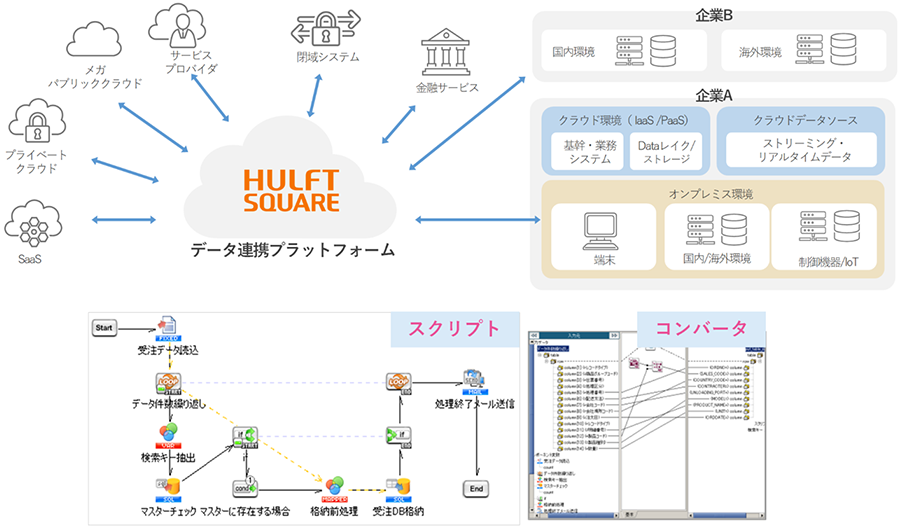
»Learn more about HULFT Square
data integration challenges brought about by increasing business complexity
While data integration between systems can improve the efficiency of many operations, there are also issues that cannot be resolved by this alone. As on-site operations become more complex, simply "connecting data" is no longer sufficient.
For example, when a single process spans multiple systems, simply combining the connections makes it difficult to control the order and conditions.
- Once processing is complete on one system, start the next system
- Automatically switch between different processing flows depending on conditions
- Adjusting execution timing due to differences in domestic and overseas execution schedules
Furthermore, when looking at the overall business process, it is not uncommon for multiple collaboration flows to operate simultaneously and in parallel, with mutual dependencies. In such situations, a system is required to adjust and manage the "entire business process" rather than each collaboration unit.
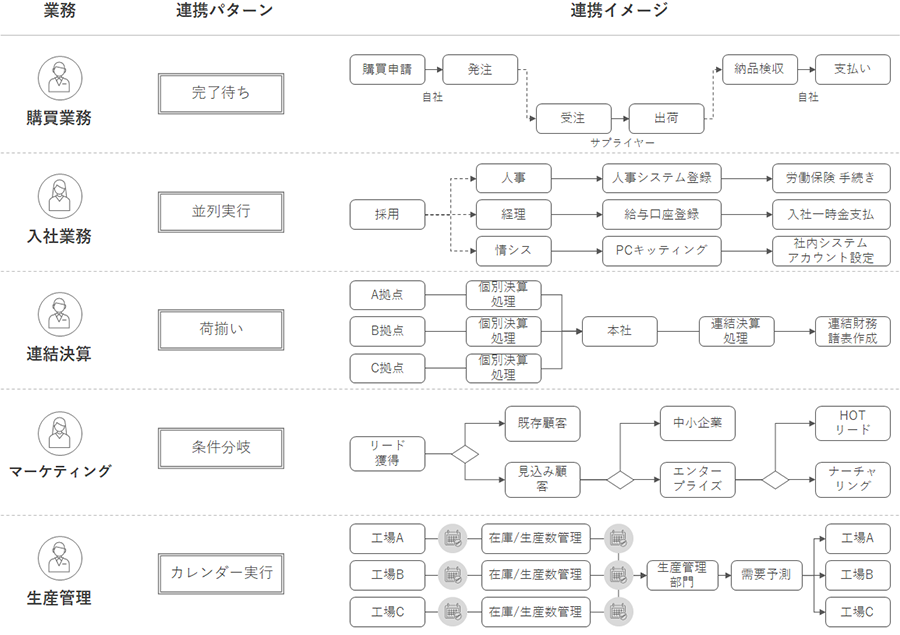
Orchestration service for comprehensive control of complex collaboration
The mechanism that enables the coordination and management of all such operations is the orchestration service.
By utilizing orchestration services, rather than managing individual systems and data integration one by one, you can design the entire business as a single flow and reliably execute and control it. As a result, even complex business operations can be operated "without interruptions" and "without relying on human intervention."
A representative orchestration service is the "Fujitsu Workload Operations Integrator" provided by Fujitsu.
Workload Operations Integrator is a solution for customers who want to achieve rapid, high-quality operation of digital services, including data utilization. It ensures stable operation and quality of processing linkages between cloud services and systems.
Orchestration service that is highly compatible with HULFT Square
Fujitsu Workload Operations Integrator
Orchestration services that ensure stable operation of digital services and contribute to accelerating digital transformation
Manage cloud services and existing environment processes to streamline operations
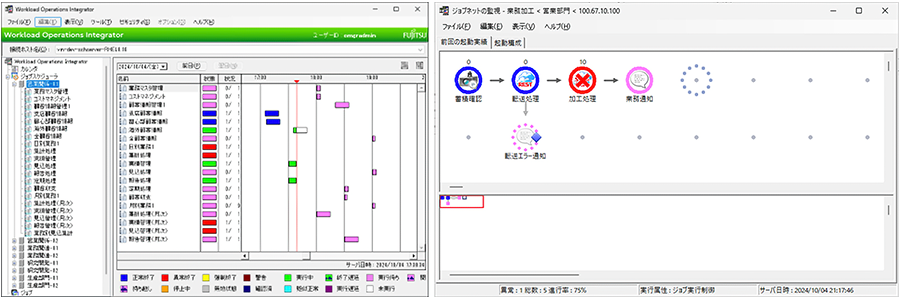
»Learn more about Fujitsu Workload Operations Integrator
Division of roles is key: How to combine orchestration and data integration
By linking the orchestration service with data integration service, you can efficiently control your entire business while also automating data processing between systems.
However, since the roles of the two are different, there are a few points to keep in mind when combining them.
- Clarify the division of roles
Orchestration service: Manages the overall flow of business (processing order, conditional branching, timing adjustment, etc.)
data integration service: Responsible for actual data acquisition, processing, transfer, etc.
If we are not mindful of this division of labor, there is a risk that the functions of both parties will overlap, leading to complexity, or conversely, that roles will be overlooked. - Design which system will take control in the event of a failure
For example, which one controls retries or alternative flows when a collaboration process fails?- Orchestration side oversees the entire business and recovers it
- Handling individual processing errors on data integration side
- Dealing with schedule variances
It is common for systems to operate at different times both domestically and overseas, or for processing timing to differ between cloud and on-premises systems.
In this case, the orchestration service must coordinate the execution timing of the entire business, while data integration service must wait and re-execute processing as necessary.
As such, when combining the two, the key to success is to carefully plan who will be responsible for what.
As a specific example, when linking the orchestration service Fujitsu Workload Operations Integrator with data integration service HULFT Square, it is possible to directly incorporate HULFT Square 's processing into the Workload Operations Integrator business flow.
The strength of iPaaS is its ability to utilize existing application components, which leads to efficient overall design.
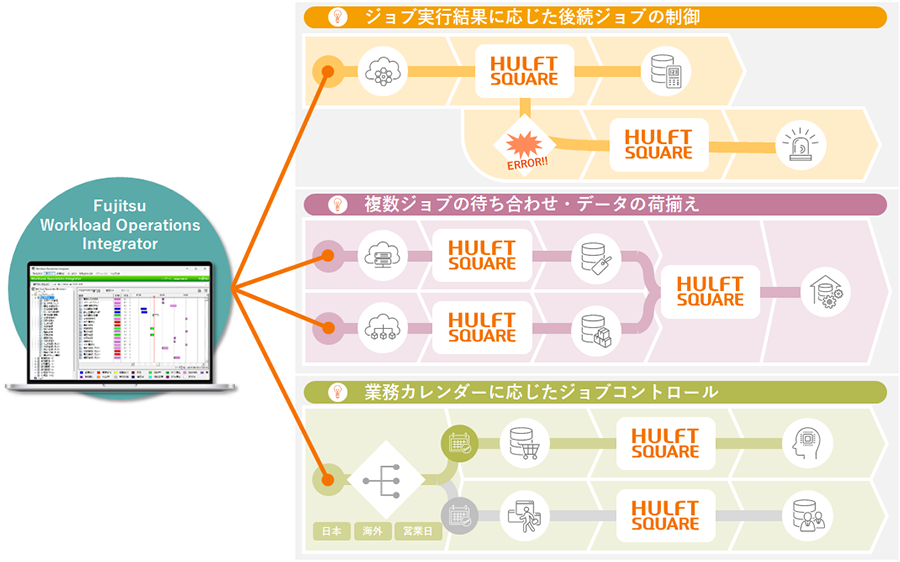
»What is HULFT Square application?
Request information/inquiries here
As we have seen so far, data integration between systems is just the starting point for improving business efficiency.
The more complex the business becomes, the more essential it becomes to orchestrate data integration processes and to design and control them from a holistic perspective.
We help solve various system integration issues, including our data integration platform" HULFT Square."
We can also advise you on how to combine it with the optimal orchestration service to suit your business.
- I would like to obtain detailed information about HULFT Square
- There are issues with your company's system integration and business processes.
- I want to know how to specifically combine it with orchestration services.
If you have any requests, please feel free to contact us.
- Request information/inquiries about HULFT Square
For inquiries or requests for information about HULFT Square, please contact us using the link below.



- Inquiries about collaborative solutions
For inquiries regarding Fujitsu Workload Operations Integrator and this integrated solution, please contact the following: