
The proliferation of collaboration methods makes system operation management difficult to control
--Standardizing the integration layer to enhance visibility and responsiveness
HULFT problem-solving solutions | For information systems departments
Operational burden caused by non-standardized data integration
Monthly closing processing, linking order data, updating inventory information, and exchanging data with external parties.
Although each task may be independent, in reality there are dependencies between them, they are subject to time constraints, and they operate across multiple departments and systems.
To keep these operations running smoothly, many companies use system operation management infrastructure to control the entire business flow through mechanisms such as controlling execution schedules, organizing dependencies, conditional branching, and re-execution management in the event of a failure.
On the other hand, data integration handled within business flows tends to have a structure in which various methods coexist.
- API integration with SaaS
- Transferring data between the cloud and on-premise
- File exchange with external companies
- Mixing real-time and batch processing
As a result, the following problems become apparent in the field of system operation:
- The collaboration method is not unified, making it difficult to grasp the overall picture
- When a failure occurs, it is not possible to immediately determine how much data has been processed.
- The starting point of the re-execution is unclear, and it takes time to identify the scope of the impact.
- Difficult to maintain consistency in terms of audits and security controls
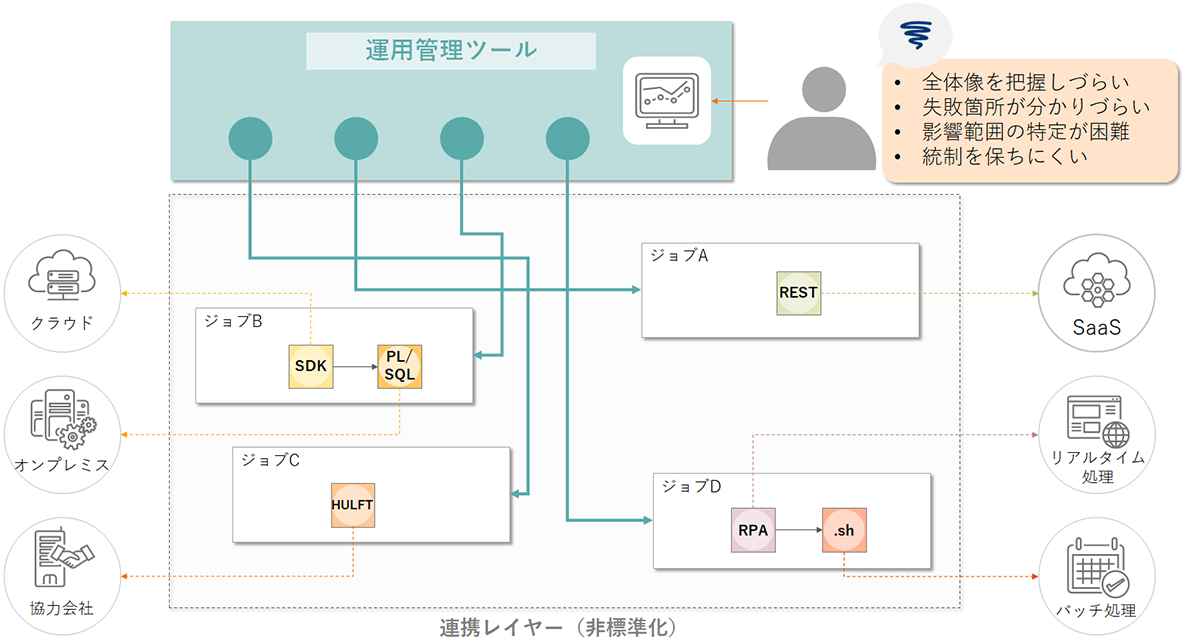
The problem lies in the "individual optimization" of the collaboration layer
If you choose the quickest way to implement each new business or system, data integration will become a series of individual responses, making it difficult to control, visualize, and redesign the entire business.
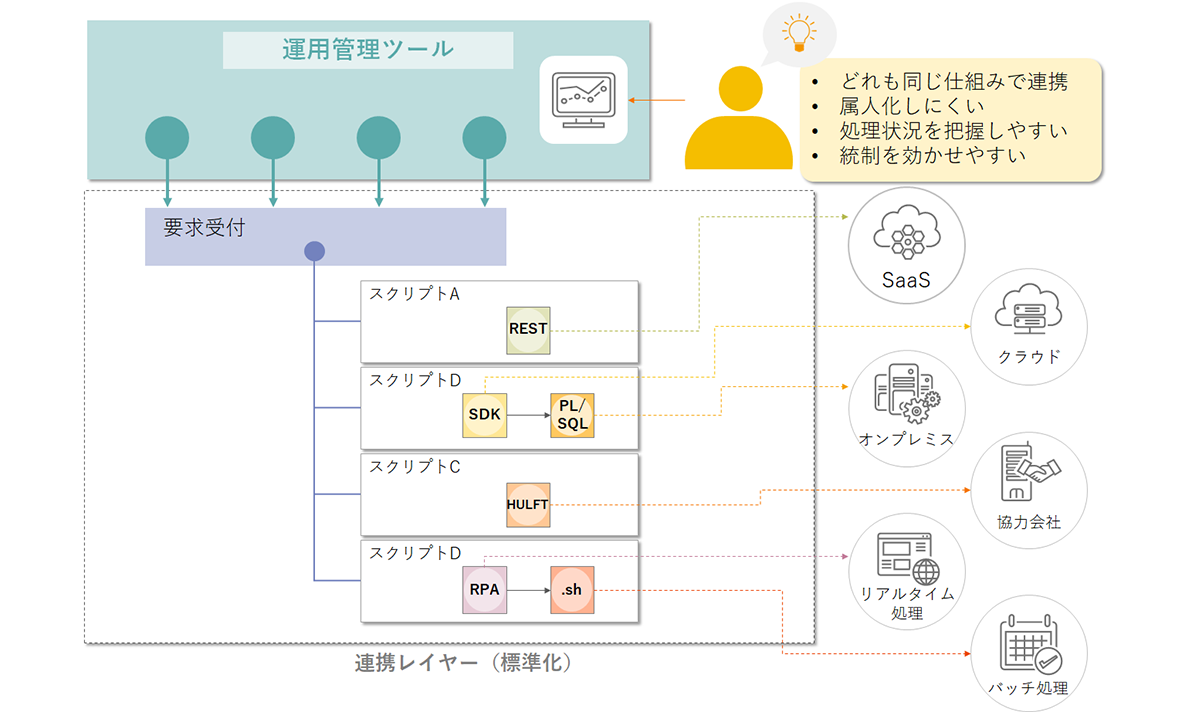
To resolve this situation, it is important to separate "integration" and "control" and standardize the integration layer as the foundation. This will allow the entire business to evolve from a "patchwork" to a "controlled structure."
in particular,
- Unified management of various collaboration methods
- Centralized visualization of execution results and logs
- Define the re-execution unit at the design stage
- Controlling security policies at the collaboration layer
By treating collaboration as a "foundation" rather than a "component," it is possible to create a structure that is consistent with business control through job management, thereby reducing operational burden.
iPaaS that standardizes data integration layer -HULFT Square
A concrete option for standardizing on an integration layer is iPaaS.
HULFT Square is a cloud-based data integration platform (iPaaS) that enables the design, execution, and management of data integration across internal and external systems, SaaS, and cloud/on-premise systems using a unified system.

»iPaaS-based data integration platform HULFT Square
HULFT Square is a Japanese iPaaS (cloud-based data integration platform) that supports "data preparation for data utilization" and "data integration that connects business systems." It enables smooth data integration between a wide variety of systems, including various cloud services and on-premise systems.
HULFT Square provides the following value to address system operation challenges:




Integrated system operation management with high compatibility with HULFT Square

JP1 Job Management is a product that provides integrated control over the automation of the entire business process across cloud and on-premise environments, ensuring stable business operations.
JP1 job management includes the following services and products:
By combining HULFT Square data integration platform with JP1 job management for business control, the entire operation will evolve along the three axes of "automation, visualization, and stabilization."
automation
- Combined calendar and event control
Trigger processes by combining events such as calendar schedules, file updates, email receipts, and time elapses - Flexible conditional branching (connectivity and flexibility)
Depending on the execution results of HULFT Square, it is possible to move from the normal route to an exception route and automatically switch to subsequent processing. - Automating "waiting" for multiple processes
The completion of multiple linked processes is used as a signal, and subsequent processes can proceed seamlessly once all data is collected.
visualization
- Centralized monitoring and operation
Visualize the entire flow of distributed environments on a single screen, clearly displaying success, failure, and incomplete status.

stabilization
- Efficient recovery
By dividing and managing the data processing flow, it is possible to pinpoint and re-execute from the point where a failure occurred, or resume work from where it was interrupted or put on hold. - Standardization of response to failures
Responses to failures have changed from "tasks that only one person can do" to standardized operations that anyone can perform without fail, improving business continuity.
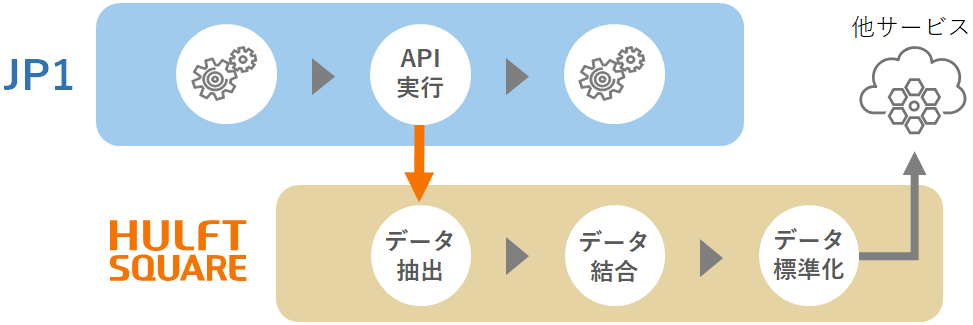
How to integrate HULFT Square and JP1
HULFT Square provides pre-created data integration scripts as easy-to-reuse packages, and also offers a free automated system operations management application that utilizes HULFT Square and JP1 job management.
Request information/inquiries here
In this way, by standardizing data integration as a "foundation" rather than a "component" and converting it into a structure that is consistent with job management, it is possible to achieve visualization of the entire business and stabilize operations.
The combination of HULFT Square and JP1 is a concrete way to put this into practice.
We help solve various system integration issues, including our data integration platform" HULFT Square."
We can also advise you on how to combine it with the most suitable job management service to suit your business.
- I would like to obtain detailed information about HULFT Square
- There are issues with the company's schedule management and individualized operational processes.
- I want to know how to combine it with JP1 job management and the scope of automation.
If you have any requests, please feel free to contact us.