

Future disaster prevention digital transformation realized through data integration platform (Part 2)


In recent years, disaster prevention digital transformation has become an urgent need to protect the lives and property of residents from increasingly severe natural disasters. Linking and integrating the wide range of data held by local governments and private companies is key to realizing faster and more accurate responses when disasters occur.
This article explains the step-by-step process to ensure the successful implementation of this data integration platform.
How to promote disaster prevention data integration
It is important to proceed with disaster prevention data integration in stages, first linking systems, then linking local governments, and then expanding to cross-industry collaboration.
With many organizations currently implementing their own disaster prevention systems, it is not easy to integrate them all at once. It is effective to clarify how to collect and utilize the information that is truly needed in an emergency, and then take a step-by-step approach accordingly.
▼I want to know more about data integration / data integration platform
⇒ data integration / data integration platform | Glossary
Phase 1. Cooperation between disaster prevention systems
The first step is to link together systems that are essential for disaster prevention, such as meteorological and river information. By linking multiple systems that have previously been operated independently, we can speed up the process from information gathering to decision-making.
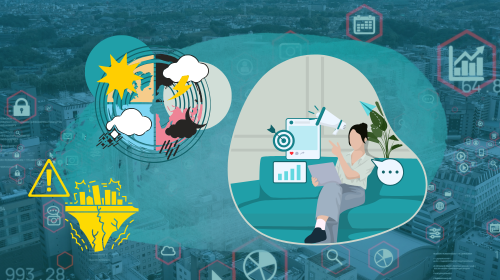
Weather information x River flood information
Combining precipitation data with river water level data allows for more accurate prediction of river flood risk. Understanding the relationship between rainfall trends and rising water levels in a specific area makes it easier to accurately determine the timing for evacuation.
Landslide information x Road information
Overlaying information on landslide warning areas with road conditions makes it easier to determine road closures and secure emergency routes in the event of a disaster. Visualizing impassable areas is useful for early detour route planning and for considering routes for transporting relief supplies.
Evacuation center information x location information
Efforts are underway to display the real-time operating status and congestion level of evacuation shelters on a map, in addition to their addresses and capacity. This not only allows residents to quickly select a safe evacuation destination, but also makes it easier to plan evacuation for those who require assistance (such as people with disabilities or the elderly). By linking this with location information, it is expected that it will be possible to provide comprehensive support for route searches and securing transportation through disaster prevention apps and disaster prevention emails.
Phase 2. Collaboration across local government boundaries
This is the stage where municipalities, prefectures, the national government, and research institutions share the same disaster information and strengthen cooperation systems. When widespread disasters or damage occur in a chain reaction, it is difficult for a single local government to respond on its own. Therefore, it is important to establish a system in which urban and surrounding areas can work together to share relief supplies and aim to create a system in place to accept evacuees.
Cooperation at the municipal level
Interoperating disaster prevention maps and apps owned by neighboring municipalities will make it easier to formulate wide-area evacuation plans. Collaboration will enable the smooth delivery of relief supplies such as surplus food and blankets to areas in need, leading to more effective disaster response.
Prefectural level cooperation
The disaster response headquarters for the entire prefecture will collect information at the municipal level and provide prioritized support as needed. At the same time, by collecting information obtained from medical institutions and public transportation within the prefecture, more precise disaster response plans can be formulated. An advantage is that in the event of a wide-area evacuation, evacuation routes and accommodation facilities can be assigned from a prefectural perspective.
Collaboration at the national and research institution levels
The Cabinet Office, the National Research Institute for Earth Science and Disaster Resilience, and others are spearheading efforts to build a nationwide disaster prevention data platform. In the event of a large-scale disaster, cooperation with local governments is essential to ensure a rapid response under central command, including the national government. The Disaster Prevention DX Public-Private Co-Creation Council, promoted by the Digital Agency, brings together a variety of participants to consider the establishment of rules for data integration and operational improvements.
Phase 3. Collaboration across industry boundaries
We are now at the stage where data integration with fields that do not seem to be directly related to disaster prevention, such as medical care, logistics, infrastructure, and agriculture, will prove extremely useful in times of disaster. Based on business and service operations during normal times, it will be important to have a system that switches information and resources to disaster prevention in emergencies.
Disaster prevention × medical care × welfare
By linking patient data held by medical institutions and welfare facilities with disaster prevention systems, it becomes possible to quickly triage patients in the event of a disaster and provide evacuation support for those requiring special care. By sharing information managed through telemedicine and electronic medical records during normal times in the event of a disaster, doctors and caregivers can aggregate and utilize their information resources.
Disaster prevention x logistics
By linking with inventory information and transport route information managed by logistics companies, relief supplies can be delivered to disaster-stricken areas at the right time and in the right quantities. One of our strengths is that we can apply delivery and warehouse management that we carry out in normal times to emergency transport in the event of a disaster.
Disaster prevention × infrastructure
Linking electricity and water demand data held by infrastructure operators with disaster prevention information will make it easier to detect supply disruptions early and identify affected areas. Utilizing data accumulated during normal times will help identify areas where supply shortages are expected and create a system for swift restoration.
Disaster prevention x Agriculture
Data accumulated through smart agriculture, such as information on crop growth status and security monitoring systems, can also be used for disaster prevention. In the event of a large-scale disaster, logistics may be disrupted, making it important to ensure food is supplied directly from farmland and warehouses.
Disaster prevention x transportation
Linking transportation operators' operational status and congestion information with disaster prevention systems makes it possible to secure evacuation routes and smoothly manage the movement of emergency vehicles. Operational data during normal times is an important indicator for understanding the flow of people, and can be used to prioritize the introduction of vehicles in the event of a disaster.
Finally
data integration platform strengthens information sharing with stakeholders in the region by data integration with various systems, regardless of local government or industry. Future disaster prevention will require effectively incorporating the trend toward digital transformation centered on data integration platform, ensuring both the safety of residents and the sustainable development of the region.
The person who wrote the article
Related Columns
-

Management speed is determined by structure: Reforming the decision-making process of a regional bank through data integration and AI.
-

Accounting systems cannot be changed, but self-assessment can. —A case study from a regional bank
-

"SAP is difficult to use..." A solution to avoid the add-on hell: "SAP Offloading"
Recommended Articles
-

Future disaster prevention digital transformation realized through data integration platform (Part 1)
We will explain the overview of disaster prevention digital transformation to improve response capabilities and efficiency during disasters, issues related to data utilization, and the role of data integration platform. -

Achieving DX for local government and administrative organizations while promoting in-house development
We will introduce solutions using use cases to address issues such as data utilization and business automation in local governments. -

Glossary MJ+
(Administrative office standard characters)This article explains the character sets that the Digital Agency is working to standardize and develop so that they can be commonly used in the IT systems of government ministries and agencies and local governments.