

Quantum cryptography / Quantum key distribution (QKD) / Quantum key distribution protocol BB84
Quantum cryptography / Quantum key distribution (QKD) / Quantum key distribution protocol BB84
This glossary explains various keywords that will help you understand the mindset necessary for data utilization and successful DX.
This time, we will explain quantum cryptography, a technology that achieves unprecedented security and peace of mind by using the properties of quantum mechanics to make eavesdropping itself impossible.
Quantum cryptographic communication / Quantum Key Distribution (QKD)
Quantum cryptography is a technology that protects the confidentiality of communications by making eavesdropping impossible through a mechanism that theoretically can always detect if someone is eavesdropping along the communication path, utilizing the properties of quantum mechanics where "the act of observing an object itself changes the state of the observed object."
Quantum key distribution (QKD) is a variation of quantum cryptography that enables the transmission of random number sequences without eavesdropping. By using a sufficiently long, securely transmitted random number sequence as the encryption key for symmetric-key cryptography, it achieves secure communication. An example of a method for implementing quantum key distribution is the BB84 protocol.
This approach fundamentally differs from conventional cryptographic techniques that ensure security by making the calculations necessary for decryption virtually impossible. It's also important to note that this technology is distinct from quantum computers (which utilize the properties of quantum mechanics) and post-quantum cryptography.
⇒ Symmetric-key cryptography / DES / AES (Advanced Encryption Standard) | Glossary
⇒Post-Quantum Cryptography (PQC) / Quantum Computer / Cryptogility / Harvest Attack | Glossary
"Theoretically secure" encrypted communication based on quantum mechanics (physics)
The reason quantum cryptography is attracting attention is that while IT is being used more and more widely in society, ensuring the safety and security of data and communications is becoming increasingly difficult.
Now that many societal activities depend on IT, ensuring the security of data and communications and making them usable on a daily basis has become essential for maintaining social activities. If a serious problem occurs, social activities will have a major impact, but at the same time, the threat of malicious attacks is higher than ever before.
In recent years, particularly, there have been instances of highly sophisticated attacks carried out by groups supported at the state level. Furthermore, the threat posed by generative AI has increased, with frontier AI (cutting-edge generative AI) discovering a large number of vulnerabilities. In addition, the risk of existing cryptographic technologies being broken by quantum computers has also become a topic of discussion.
While its importance is greater than ever, so are the threats it poses. The highest level of caution is especially desirable in areas related to national security. This is where "quantum cryptography," a technology that achieves a level of security and safety that is on a different level from other technologies, based on the laws of physics, is attracting attention.
The security of quantum cryptography is fundamentally different from that of conventional cryptographic technologies.
When you hear the term "quantum cryptography," you might think it's something that uses quantum mechanics to enhance conventional cryptographic techniques, such as a high-level version of AES or lattice-based cryptography. However, that's not the case.
The security considerations in traditional cryptography: It's not secure because the computational effort required to decrypt it is too great.
Traditional cryptographic techniques have ensured security by knowing how to decrypt the data, but by requiring an excessive amount of computation to do so. In other words, even if encrypted data is intercepted, it is virtually impossible to convert the ciphertext back into plaintext using known decryption methods, thus ensuring security.
However, the reason it's considered secure is simply because it cannot be practically deciphered "by known methods," not because it has been mathematically proven that there is "absolutely no" way to practically crack the code.
- Basis for safety: It is safe because the computational load is too large.
- Because decryption requires an enormous amount of computation, it is practically impossible to decrypt even with a very high-performance supercomputer (with known decryption methods).
- Safety risks: Theoretical proof of safety has not been made.
- It cannot be ruled out that there are actually efficient cryptography techniques that are not yet known, and that using them could potentially lead to the decryption of codes.
- While a cryptographic technique can be considered theoretically secure if it has a mathematical proof of its security (such as proving that a certain amount of computation is always required to execute it), unfortunately, widely used cryptographic techniques do not have such proof.
Therefore, we cannot prove that there is no serious risk that an algorithm exists that can efficiently decrypt messages, and that a few countries that know its secret are freely decrypting them. Moreover, in this era of increasing practical use of quantum computers, the uncertainty about whether there is absolutely no risk of decryption through unexpected means only increases.
Quantum cryptography: Creating a communication channel that is impossible to eavesdrop on due to "physical laws."
In contrast, "quantum cryptography" creates security for communication channels in a completely different way.
- Security justification: It is "theoretically impossible" to steal data through eavesdropping.
- Theoretically, if someone intercepts data along the communication path, it should always be detectable.
- If we can theoretically guarantee that "no one is eavesdropping," then we can eliminate the possibility of data leakage altogether.
For someone with malicious intent to steal or tamper with data, they would need to intercept the data along the transmission path. If it can be proven that "no eavesdropping whatsoever" occurred along the transmission path, then it can be confirmed that there is no possibility of data leakage.
"Quantum cryptography" is a technology that creates a communication channel that can be verified using physical laws to ensure that "no one is eavesdropping (observing) along the way." You might think that such a magical thing is not even possible, but it is possible by "using the properties of quantum mechanics." It is a technology that does something a little unbelievable, but quantum cryptography is a technology that is beginning to be put into practical use and is starting to be used in reality (quantum computers are still in the process of being put into practical use, but quantum cryptography is starting to be put into practical use).
"How does quantum cryptography create an uneavesdroppable communication channel?"
Quantum cryptography is realized by utilizing the mysterious properties of quantum mechanics, such as "the act of observation itself can sometimes change the state of the observed object" and "it may not be possible to observe two properties of an observed object simultaneously."
Double-slit experiment: The mysterious properties of quantum mechanics
There is a famous physics experiment called the "double-slit experiment" that allows us to observe mysterious phenomena in the world of quantum mechanics. To put it simply, it is an experiment in which a device that emits electrons, a screen that can detect when electrons collide, and a "double slit" (a slit with two long, narrow holes running vertically) are placed between them.
- Double-slit experiment
- [Electron-emitting device] – Electron -> [Double slit] – Electron -> [Screen]
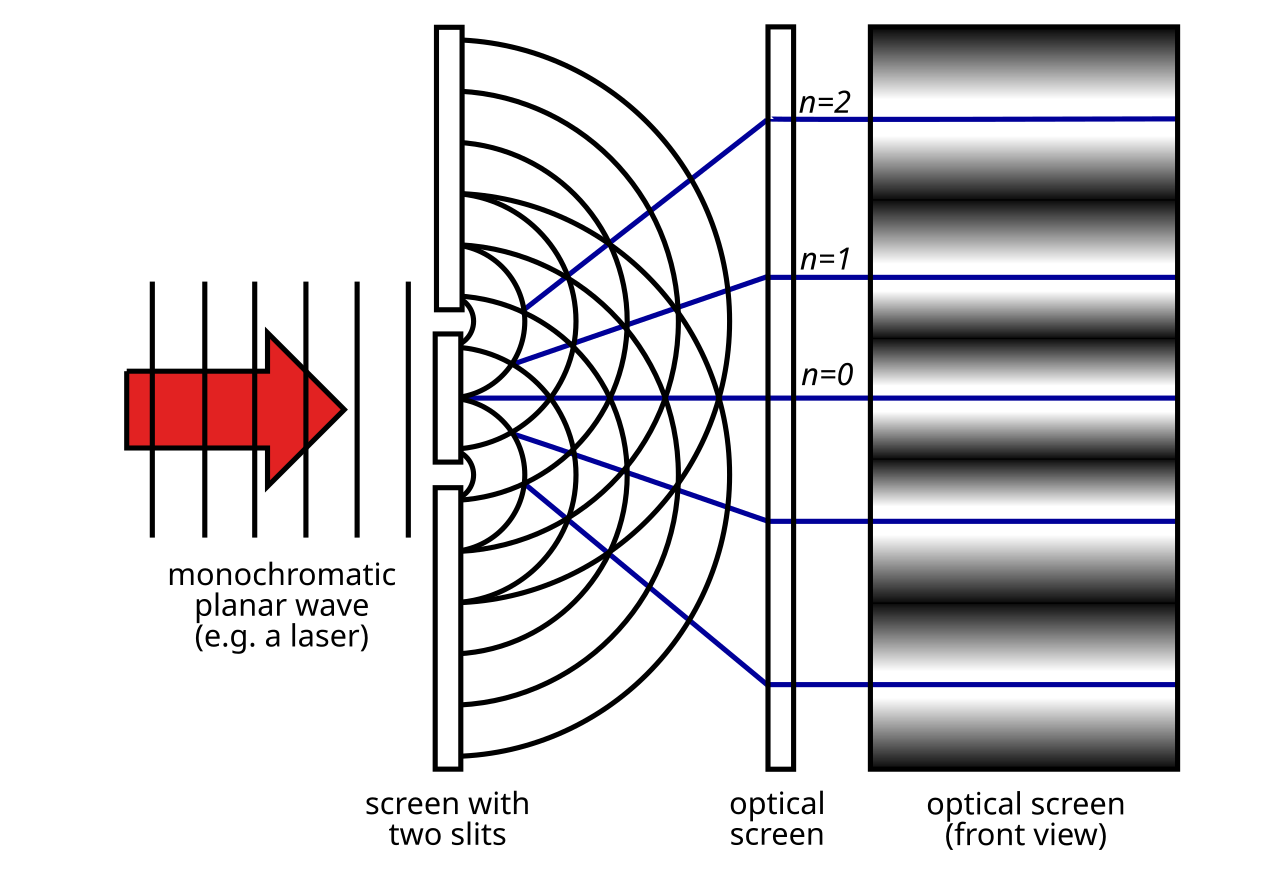
Now, what kind of pattern will appear on the screen?
If we consider this using our everyday common sense, a double slit has "slit A" and "slit B," and electrons pass through one of them. In that case, it seems that there would be "a pattern on the screen created by electrons that passed through slit A" and "a pattern on the screen created by electrons that passed through slit B."
- Our image
- Electrons are emitted.
- The electron passes through either slit A or slit B.
- Wouldn't the screen create a pattern consisting of two clusters: one made up of electrons that passed through slit A, and the other of electrons that passed through slit B?
However, when you actually perform the double-slit experiment, a "striped pattern" gradually appears on the screen.
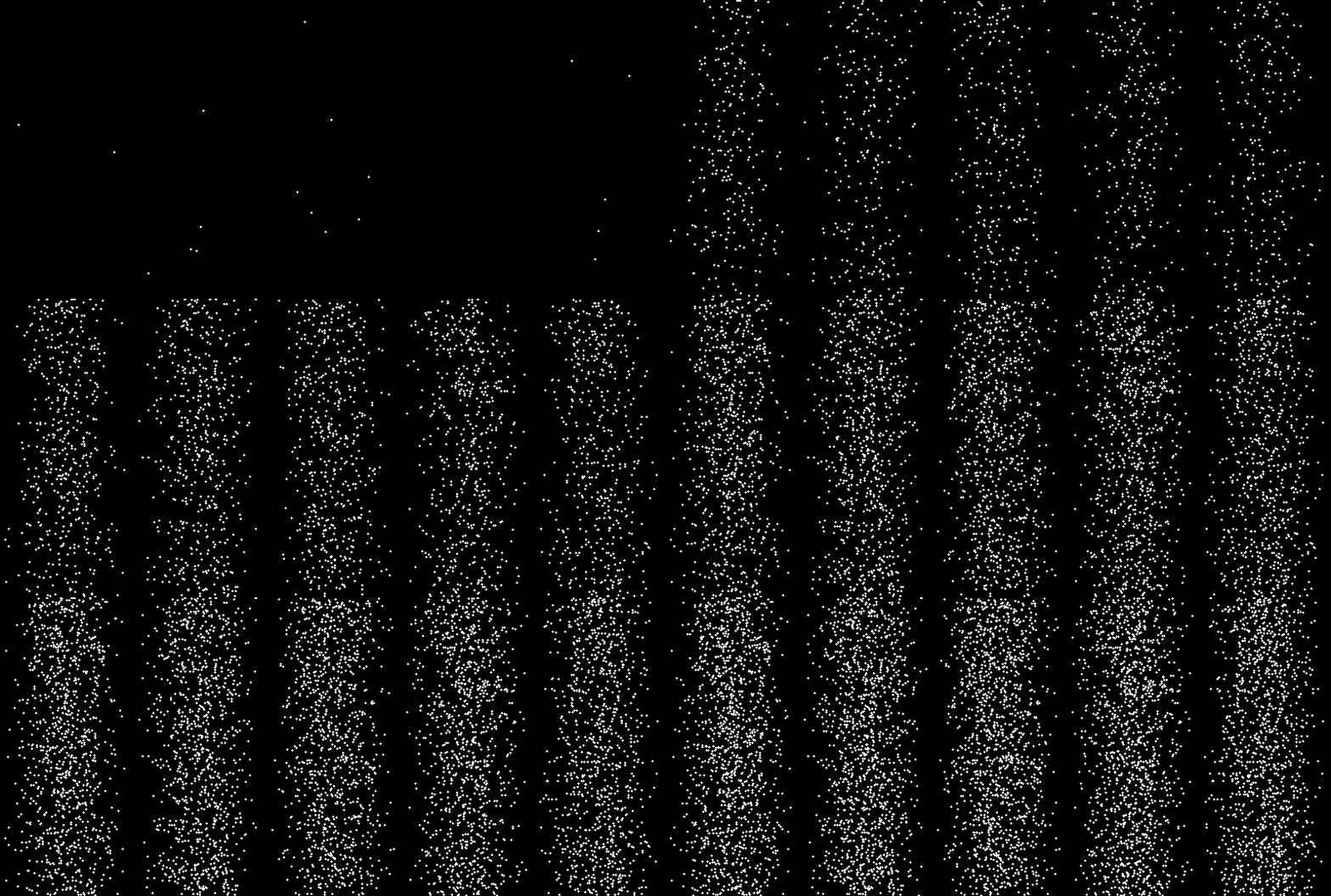
What exactly happened to make this happen? In the world of quantum mechanics, electrons are not emitted as "particles" and travel along specific paths, but rather exist as a "cloud of probabilities of electrons existing in a given area" within a spread-out region of space. The following is a rough analogy,
- The Real World of Quantum Mechanics
- Electrons are emitted.
- Electrons are emitted as a "probabilistic wave" representing "the probability that an electron exists at that position."
- The "probabilistic wave of electrons" travels through space and arrives at the double slit.
- Since it is a wave, it reaches both "slit A" and "slit B," and the wave passes through both slits.
- Even if only one electron is emitted, the electron will pass through both slits (!).
- "Probabilistic waves of electrons" are emitted from both "Slit A" and "Slit B" toward the screen.
- Two waves interfere with each other on the screen, creating a striped pattern.
- Electrons are emitted.
What does it mean for "two waves to interfere"? Waves have "high points (peaks)" and "low points (troughs)." When two probability waves collide, areas where "high points overlap" and areas where "low points overlap" are created, resulting in a striped pattern. In the diagram below, you can see that waves are emitted from each slit, and the interference of these waves explains how the striped pattern is formed.
Double-slit experiment: What if we made an observation midway through?
We explained that electrons pass through both slits as "stochastic waves" (contrary to our everyday intuition). Even if only one electron is emitted, it will pass through both. So, if we observe whether an electron has passed through the slits, will we actually detect that it has passed through both?
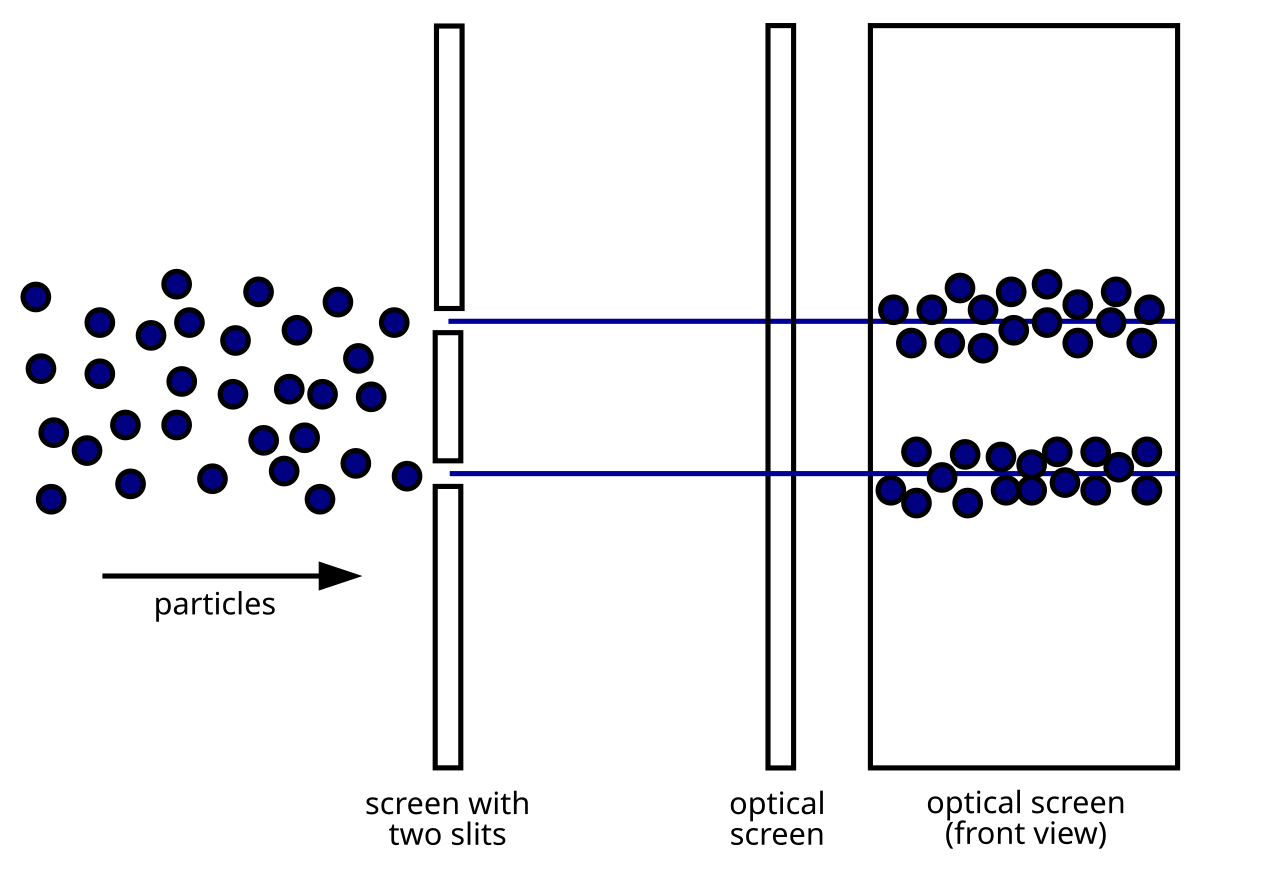
Surprisingly, simply observing electrons through a slit can change the experimental results.
- When electrons are observed in a slit
- Electrons are emitted.
- Electrons are emitted as "stochastic waves" and arrive at the double slit.
- However, when observing electrons with a slit, the electrons are detected only in either "slit A" or "slit B".
- The moment an electron is observed, the probabilistic wave state is lost, and it simply passes through one of the two directions.
- On the screen, only patterns representing "passing through slit A" and "passing through slit B" will be created; no striped patterns will be produced.
- Electrons are emitted.
The experiment was identical except for the presence or absence of observation, but the results changed. This illustrates how, in the world of quantum mechanics, the state of an observed object can change simply by being observed.
Double-slit experiment: Can be used to check if someone is eavesdropping?
These experimental results can also be interpreted in the following way.
- We are only watching the patterns that appear on the screen; we have absolutely no idea what's happening at the slits.
- However, the "pattern on the screen" allows us to determine whether someone observed the slit's position.
In other words, you can tell whether someone was observing (eavesdropping) along the way, or whether no one was observing, simply by looking at the pattern on the screen. You can determine whether or not no one was eavesdropping along the way based on the laws of physics (quantum mechanics).
It is sometimes impossible to observe two properties of an object simultaneously.
In the world of quantum mechanics, it is sometimes impossible to observe two properties of an object simultaneously. For example, it is impossible to precisely measure both "position" and "momentum" (think of it like velocity).
If we accurately measure the "position" of an object, we lose the ability to accurately determine its momentum, and if we accurately measure its momentum, we lose the ability to determine its position. It might seem like we could just take two measurements, but as explained earlier, the state changes simply by taking the measurement, so this is not possible.
Quantum cryptography uses the property that "property A of the observed object" and "property B of the observed object" cannot be observed simultaneously, and "if one is observed, the other becomes unknown."
Quantum Key Distribution Protocol BB84
(Although this is a rough explanation) By using the "two properties" I've introduced, it's possible to achieve encrypted communication that "cannot be detected or eavesdropped on." I will now introduce the "BB84 protocol," which is a method that is actually being put into practical use.
This can be achieved with existing "optical fibers".
When you hear about encrypted communication using quantum mechanics, you might imagine some kind of unfamiliar hardware being used to implement it, but it can actually be implemented as optical communication using the fiber optic lines already laid throughout Japan, or as wireless communication between ground antennas and communication satellites in space.
When using optical fibers, information is transmitted by being carried on "photons." Information is transmitted by carrying it on photons, which are in a quantum state (a state of probability waves), and the receiving end observes it to receive the data.
Two "modes"
Since it's digital communication, data is transmitted as "0"s and "1"s, but we have two encoding methods. Think of the following as simply having two cases: "vertical and horizontal" and "diagonal" depending on the direction of light vibration.
- Portrait and landscape modes
- |:0
- ─:1
- Diagonal mode
- /:0
- \:1
These two modes must be in a relationship where "it is not possible to observe both properties simultaneously." In other words, if you observe in "vertical/horizontal mode," you will not obtain observation results in diagonal mode, and if you observe in diagonal mode, you will not obtain observation results in vertical/horizontal mode.
Sending data
The transmitting side randomly selects one of two transmission modes. Then it sends either a randomly generated "0" or "1". In this way, data is transmitted one bit at a time.
Receiving data
The receiving end receives a signal, but it doesn't know which transmission mode was used. It randomly selects one of the two modes and receives the received signal.
If the modes happen to match, either "0" or "1" will be received precisely. If the modes are different, either "0" or "1" will be received randomly. Since the quantum state is destroyed after one observation, a second observation is not possible, and reception in both modes is not possible.
Verification of received data
After all the required bits have been transmitted, both parties send an "answer" indicating which "transmission mode was used" and which "reception mode was used." This reveals which bits are presumed to have been received correctly and which bits were not received correctly.
Bits that were not received correctly are discarded. A certain percentage of bits are selected from the bits that are presumed to have been received correctly and sent to each other for testing, so that the sender and receiver can confirm that the sent data and the received data match.
If there are no problems, all bits should match during the verification process, leading to the conclusion that "the data was transmitted securely" and "the remaining random bits not used in verification were transmitted securely."
If a bit mismatch is found, it is determined that there are two possibilities: "the data may have been corrupted due to noise in the communication path" and "it may have been caused by eavesdropping." If the mismatch exceeds a certain level, the data is discarded as it may have been intercepted and is therefore insecure.
Secure encrypted communication is achieved using the delivered "encryption key".
This mechanism allows for secure data transmission by using a "random number sequence transmitted securely without eavesdropping" as the "cryptographic key for symmetric-key cryptography." In other words, the BB84 protocol is not a protocol for securely delivering the data itself, but rather a protocol for securely sharing the cryptographic key with the recipient. Hence, it is called the "BB84 Key Distribution Protocol."
Specifically, secure data communication can be achieved by using AES encryption with a sufficiently long encryption key. For even greater security, you can send an encryption key the same length as the data to be sent, perform an XOR (exclusive OR) operation on the data to be sent and the encryption key (which is a sequence of random numbers) to make it indistinguishable from the random numbers before sending the data, and then use the encryption key only once (Vernam cipher/one-time pad). This theoretically makes the data unbreakable.
- Send an unintercepted random number sequence using the BB84 key distribution protocol.
- By using that random number sequence as the encryption key for symmetric-key cryptography, secure data communication is achieved.
- By using it as the symmetric key for AES encryption
- Using a Vernam cipher (one-time pad) can theoretically achieve unbreakable security. However, it requires the use of a disposable encryption key that is the same length as the transmitted data.
Furthermore, quantum cryptography has also devised mechanisms for securely transmitting arbitrary data itself, and attempts are being made to directly implement mechanisms like public-key cryptography as quantum cryptography. Therefore, it is not always the case that a key distribution mechanism like BB84 is used.
How does this system prevent eavesdropping?
So, how does this mechanism prevent eavesdropping? The key point is that when receiving data, "it's impossible to know what transmission mode was used."
Similarly, the attacker will have to estimate the transmission mode when receiving the data, meaning they cannot know the exact data that was sent, nor can they determine whether they selected the correct receiving mode. Furthermore, since the data will not reach the receiver if it is intercepted midway, the eavesdropper will need to resend the data.
- If the eavesdropper's receiving mode happens to match
- We are able to eavesdrop on the correct data.
- The correct data can be resent to the recipient (eavesdropping successful).
- If the eavesdropper's receiving mode did not actually match
- The received data is random, consisting of either 0s or 1s, but I don't know why (the eavesdropping failed, but I don't know why).
- The receiving end will end up resending random data, meaning there is a 50% chance that the recipient will receive incorrect data.
In other words, this is what happens when there is or is no eavesdropping. During the verification process between the sender and receiver,
- If there is no eavesdropper, the correct bits will be delivered from the sender to the receiver.
- No problems were found during the verification process.
- If there is an eavesdropper, there is only a 75% chance that the correct bits will be received.
- When the mode estimated by the eavesdropper happens to be correct (100%), and when it is incorrect (50%), the signal is only successfully transmitted 75% of the time (100% × 50% + 50% × 50% = 75%).
- The verification process can detect an increase in the frequency of incorrect bits.
In other words, when eavesdropping occurs, "25% of the data will inevitably become corrupted," so the change in data can be used to detect that eavesdropping has taken place. It's a well-thought-out system.
Quantum cryptography is also beginning to be offered as a commercial service.
Unlike quantum computers, which are still under research and development but not yet at a practical level, quantum cryptography has reached a stage where limited commercial services are being offered in some areas.
This can be achieved using existing fiber optic lines (however, dedicated equipment is required).
While communication technology that utilizes the principles of quantum mechanics might seem to require special communication infrastructure, existing transmission lines can be used.
For example, quantum key distribution using the BB84 protocol can be implemented using the "optical fiber" network that already extends throughout Japan. However, the equipment used for transmission and reception will require special devices that differ from conventional ones.
Restrictions preventing communication relay
Because this method is "undetectable and unobservable" on the communication path, it not only prevents eavesdropping but also prevents "relaying." At least, this is not possible with the technologies currently being attempted for practical use (such as the BB84 protocol).
As the communication distance increases, the signal attenuates and gets buried in noise, and it's impossible to retransmit it using a repeater along the way, which presents a problem for long-distance communication.
Currently, the communication distance using the BB84 protocol with optical fiber is only about 100 to 200 km. This means that while it can reach the Kanto region centered around Tokyo, it becomes difficult to reach Shizuoka, indicating significant technical limitations.
A "quantum key distribution network" with secure relay points.
Therefore, one concept envisions realizing a quantum key distribution network by setting up "secure relay points" throughout Japan and connecting these relay points with optical fibers. The system would solve the problem of communication distance by using a quantum key distribution protocol to securely communicate between relay points and delivering the keys to their destinations via these relay points, thereby enabling key distribution throughout Japan.
However, when using a quantum key distribution network, in addition to the high level of security of quantum cryptography itself, it becomes necessary to trust that "the relay points throughout Japan are kept secure" and "the network is operating properly." Based on these factors, a comprehensive judgment must be made as to which is superior in terms of cost and security compared to conventional technologies.
High safety but high cost
While conventional optical data communication allows for extremely high-speed, high-capacity communication using a single optical fiber, the BB84 protocol can only transmit small amounts of information at low speeds, even with expensive equipment.
Furthermore, while many aspects of communication protocols and encryption technologies used in typical data communications can be implemented and modified as needed through software, the BB84 protocol, for example, relies heavily on hardware implementation, as mentioned above. This makes maintaining and updating the technology time-consuming and costly (i.e., it lacks the "cryptoagility" that has been a hot topic recently).
Therefore, it is unlikely that this technology will directly replace conventional fiber optic communication networks. Instead, it will likely be used for transmitting encryption keys for important data or as a means of transmitting extremely sensitive data.
⇒Post-Quantum Cryptography (PQC) / Quantum Computer / Cryptogility / Harvest Attack | Glossary
Extending the communication range may lead to missing eavesdropping.
The BB84 protocol detects eavesdropping as an "increase in the communication error rate" (25% of errors are inevitable). However, in real-world communication lines, communication errors can occur due to causes other than eavesdropping.
Because relaying is not possible, if we try to achieve long-distance communication while battling signal attenuation, we will have to make the most of an environment where naturally occurring communication errors are very frequent. Although error correction protocols and other measures are being developed to address this problem, it will essentially become a matter of probability, such as "the probability of being eavesdropped on is less than one in ten thousand," because it will be difficult to distinguish between eavesdropping and errors.
While it could be argued that this is indeed safe, it gives the impression that it's a completely different approach from the explanation that it's an absolutely secure technology that cannot be eavesdropped on using the properties of quantum mechanics.
Addressing issues other than wiretapping
The security requirements for encrypted communications go beyond simply preventing eavesdropping. For example, it's necessary to ensure that the sender and receiver are indeed the real people involved and not impersonators, and that data delivery can be avoided even in the event of communication interference.
While these requirements may not be issues that the BB84 protocol itself should address, they are necessary for establishing the highest level of encrypted communication channels, and simply introducing quantum key distribution does not guarantee the highest level of encrypted communication in all respects.
On the other hand, with conventional technologies, such as communication infrastructure using "post-quantum cryptography," which is currently being implemented worldwide, the necessary measures are already in place in many respects.
The otherworldly awe-inspiring power of "absolutely no eavesdropping" and the "safety and security" that is necessary to achieve on a global scale.
I think the technology was so astonishing that it made my initial skepticism—the feeling that "a communication method that is theoretically impossible to eavesdrop on" could actually exist—seem perfectly normal.
As I have explained to you in a way that you should be able to understand, the unbelievable technology that makes eavesdropping absolutely impossible is a reality, and moreover, unlike time machines or quantum computers, it is a technology that is already being commercialized and is "already available for human use."
While acknowledging its incredible potential, the presentation also mentioned the numerous difficulties involved. The inability to relay data and the challenges of long-distance direct communication are frequently discussed, but it seems there are many other obstacles to overcome before widespread adoption is possible. This explanation may have left the impression that the technology, initially presented as a dream, is ultimately disappointing.
Sometimes, "other things" are precisely what are important in achieving "safety and security."
To broaden the topic slightly, for "safety and security" technologies to become widely used in society, these "many other things" are actually more essential. More generally, the same thing is true for any IT technology or software to become widespread and practically useful.
For example, our "connecting" products have been supported for many years because they are a means of solving "many other things."
For example, even with "HULFT," the de facto standard product in file transfer middleware, people sometimes ask things like, "It just transfers files, right? (How is it different from FTP?)"
However, when considering what is necessary for a collaborative platform that can provide the "safety, security, and reliability" required to handle critical matters in real-world business operations, it is necessary to have "many things beyond file transfer itself" fully implemented, and in fact, that is a more pressing reality. The reason HULFT continues to receive strong support is because it is fully equipped in this respect.
There are many other similar situations. For example, even after implementing cloud services like kintone or Salesforce, the results may not be as expected. Often, the key to smooth implementation lies in overcoming the many other time-consuming tasks, such as data integration with external systems. Similar situations tend to occur with the use of generational AI or data analysis initiatives.
data integration middleware (EAI / ETL / iPaaS) such as "DataSpider" and "HULFT Square" allow for flexible data integration between a wide variety of systems and data sets through no-code development on a GUI. They have gained support as products that efficiently solve the problem of "reality where handling such issues is important, and in fact, time-consuming."
Quantum cryptography is a promising field for Japan.
Quantum cryptography is noteworthy for Japan's future, as it seeks "industrial sectors with growth potential." Unlike digital technologies, which tend to lead to product homogenization and cost competition, quantum cryptography requires sophisticated and delicate analog technology, as well as advanced sensor technology, an area in which Japan remains strong. If the competition is based on continuous improvement and progress, such as achieving communication up to 200km and then successfully reaching 300km, Japan still seems to have a significant advantage over other countries.
Quantum key distribution technology, which is truly a "magical technology," has begun to be commercialized in some areas, but it is not yet at a point where it will be widely used in the world. As it is a technology that will definitely be considered by those who demand the highest level of security, it seems likely that its use will first progress in areas where security is of utmost importance, such as governments and financial institutions.
However, I feel that for it to become widely used in society, it will depend on whether new use cases emerge. I hope that quantum cryptography will be widely adopted, making it an overwhelmingly strong industrial field in Japan that will support Japan in the next era, but whether that will happen depends on whether impactful new applications are proposed.
Related keywords (for further understanding)
-
Public-key cryptography / digital signatures / one-way functions
- EAI
- This approach involves "connecting" systems through data integration, providing a means to freely link various data and systems. It's a concept that has been active long before the cloud era as a way to effectively utilize IT.
- ETL
- In the recent trend of actively working on data utilization, the majority of the work is not the data analysis itself, but rather the collection and preprocessing of data scattered in various places, from on-premise to cloud.
- iPaaS
- A cloud service that "connects" various clouds with external systems and data simply by operating on a GUI is called iPaaS.
Are you interested in "iPaaS" and "connecting" technologies?
Try out our products that enable you to seamlessly integrate various data and systems, from on-premises IT systems to cloud services, and successfully leverage IT.
The ultimate "connecting" tool: data integration software "DataSpider" and data integration platform "HULFT Square"
"DataSpider," data integration tool developed and sold by our company, is a "connecting" tool with a long history of success. "HULFT Square," a data integration platform, is a "connecting" cloud service developed using DataSpider technology.
Another feature is that development can be done using only the GUI (no code) without writing code like in regular programming, so business staff who have a good understanding of their company's business can take the initiative to use it.
Try out DataSpider/ HULFT Square 's "connecting" technology:
There are many simple collaboration tools on the market, but this tool can be used with just a GUI, is easy enough for even non-programmers to use, and has "high development productivity" and "full-fledged performance that can serve as the foundation for business (professional use)."
This solution smoothly resolves the problem of "connecting disparate systems and data," which often hinders the success of IT utilization. We regularly hold free trial sessions and hands-on workshops where you can try it out for free, so we encourage you to give it a try.
Why not try a PoC to see if "HULFT Square" can transform your business?
Why not try verifying how "connecting" can be utilized in your business, the feasibility of solving problems using data integration, and the benefits that can be obtained?
- I want to automate data integration with SaaS, but I want to confirm the feasibility of doing so.
- We want to move forward with data utilization, but there are challenges in system integration.
- I want to consider data integration platform to achieve DX.
Glossary Column List
Alphanumeric characters and symbols
- The Cliff of 2025
- 5G
- AI
- API [Detailed version]
- API Infrastructure and API Management [Detailed Version]
- BCP
- BI
- BPR
- CCPA (California Consumer Privacy Act) [Detailed Version]
- Chain-of-Thought Prompting [Detailed Version]
- ChatGPT (Chat Generative Pre-trained Transformer) [Detailed version]
- CRM
- CX
- D2C
- DBaaS
- DevOps
- DWH [Detailed version]
- DX certified
- DX stocks
- DX Report
- EAI [Detailed version]
- EDI
- EDINET [Detailed version]
- ERP
- ETL (Extract/Transform/Load) [Detailed version]
- Excel Linkage [Detailed version]
- Few-shot prompting / Few-shot learning [detailed version]
- FIPS140 [Detailed version]
- FTP
- GDPR (EU General Data Protection Regulation) [Detailed version]
- Generated Knowledge Prompting (Detailed Version)
- GIGA School Initiative
- GUI
- IaaS [Detailed version]
- IoT
- iPaaS [Detailed version]
- MaaS
- MDM
- MFT (Managed File Transfer) [Detailed version]
- MJ+ (standard administrative characters) [Detailed version]
- NFT
- NoSQL [Detailed version]
- OCR
- PaaS [Detailed version]
- PCI DSS [Detailed version]
- PoC
- REST API (Representational State Transfer API) [Detailed version]
- RFID
- RPA
- SaaS (Software as a Service) [Detailed version]
- SaaS Integration [Detailed Version]
- SDGs
- Self-translate prompting / "Think in English, then answer in Japanese" [Detailed version]
- SFA
- SOC (System and Organization Controls) [Detailed version]
- Society 5.0
- STEM Education
- The Flipped Interaction Pattern (Please ask if you have any questions) [Detailed version]
- UI
- UX
- VUCA
- Web3
- XaaS (SaaS, PaaS, IaaS, etc.) [Detailed version]
- XML
- ZStandard (lossless data compression algorithm) [detailed version]
A row
- Avatar
- Crypto assets
- Algorithms / Computational Complexity Theory / P / NP [Detailed Version]
- Ethereum
- Elastic (elasticity/stretchability) [detailed version]
- Autoscale
- Open data (detailed version)
- On-premise [Detailed version]
Ka row
- Carbon Neutral
- Virtualization
- Government Cloud [Detailed Version]
- availability
- completeness
- Machine Learning [Detailed Version]
- mission-critical system, core system
- confidentiality
- Cashless payment
- Symmetric key cryptography / DES / AES (Advanced Encryption Standard) [Detailed version]
- Business automation
- Cloud
- Cloud Migration
- Cloud Native [Detailed version]
- Cloud First
- Cloud Collaboration [Detailed Version]
- Retrieval Augmented Generation (RAG) [Detailed version]
- Public-key cryptography / Digital signatures / One-way functions [Detailed version]
- In-Context Learning (ICL) [Detailed version]
- Container [Detailed version]
- Container Orchestration [Detailed Version]
Sa row
- Serverless (FaaS) [Detailed version]
- Siloization [Detailed version]
- Subscription
- Supply Chain Management
- Singularity
- Single Sign-On (SSO) [Detailed version]
- Scalable (scale up/scale down) [Detailed version]
- Scale out
- Scale in
- Smart City
- Smart Factory
- Small start (detailed version)
- Generative AI (Detailed version)
- Self-service BI (IT self-service) [Detailed version]
- Loose coupling [detailed version]
Ta row
- Large Language Model (LLM) [Detailed version]
- Post-Quantum Cryptography (PQC) / Quantum Computers / Cryptogility / Harvest Attacks [Detailed Version]
- Deep Learning
- Data Migration
- Data Catalog
- Data Utilization
- Data Governance
- Data Management
- Data Scientist
- Data-driven
- Data analysis
- Database
- Data Mart
- Data Mining
- Data Modeling
- Data Lineage
- Data Lake [Detailed version]
- data integration / data integration platform [Detailed Version]
- Digitization
- Digitalization
- Digital Twin
- Digital Disruption
- Digital Transformation
- Deadlock [Detailed version]
- Telework
- Transfer learning (detailed version)
- Electronic Payment
- Electronic Signature [Detailed Version]
Na row
Ha row
- Harvest Attack (HNDL: Harvest Now, Decrypt Later) [Detailed Version]
- Hybrid Cloud
- Batch Processing
- Hallucination (Detailed Version)
- Unstructured Data
- Big Data
- file transfer [Detailed Version]
- Fine Tuning [Detailed Version]
- Private Cloud
- Blockchain
- Prompt template [detailed version]
- Vectorization/Embedding [Detailed version]
- Vector database (detailed version)
Ma row
- Marketplace
- migration
- Microservices (Detailed Version)
- Managed Services [Detailed Version]
- Multi-tenant
- Middleware
- Metadata
- Metaverse
Ya row
Ra row
- Leapfrogging (detailed version)
- Quantum cryptography / Quantum key distribution (QKD) / Quantum key distribution protocol BB84 [Detailed version]
- quantum computer
- Route Optimization Solution
- Legacy System/Legacy Integration [Detailed Version]
- Low-code development (detailed version)
- Role-Play Prompting [Detailed Version]
Wa row
Recommended Content
Related Columns

Recommended Articles
-

How can we turn the "tacit knowledge" lying dormant within our company into "AI knowledge" and utilize it?
We will explain the specific process for turning unstructured data scattered throughout your company into an asset and maximizing the potential of AI. -
Automated classification of product masters using generative AI: How to bring a new perspective to your analysis
We will explain the new perspectives that transformation in product master management brings, through the mechanism of automatic classification brought about by generative AI and the benefits that can be gained by adopting it. -
How to get the insights you want without changing your master data
This e-book offers a new approach to solutions for companies that have data but are not making use of it.